Is Beethoven masculine?

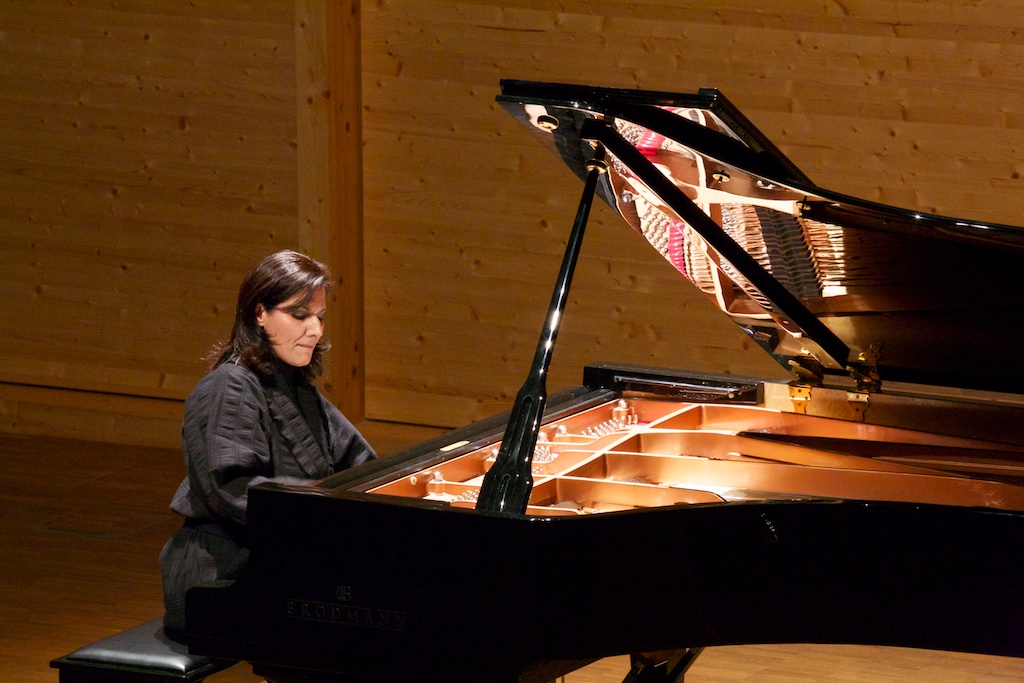
A woman plays Beethoven

„ Music is a higher revelation than all wisdom and philosophy.” (L.v.Beethoven)

Beethoven used these words to make a clear statement to the people of his time and to posterity. He considered music as the highest form of expression.
As a composer he was absolutely conscious about the strong influence of his art to other people. Beethoven had particular preference for the instrumental form of the string quartet, he also declared that his way of imagining the sound was always symphonic.
Nevertheless he found the perfect expression of all his emotional feelings through the piano sonata form.

A similar huge work cannot be found in the whole piano literature like the 32 piano sonatas compendium, which is still a difficult enterprise for a pianist, even today, about 200 years later. Mastering them requires to grow and to mature as a musician for a deeper understanding of Beethoven´s style and sound.

These works belong as well to the concert programs of pianists and complete recordings are normal practice in the classical music market.
This mammoth program contains, anyway, some special touch in its own character.
Those interpreters who are venturing to the „New Testament of piano music“ (Quote by H.v.Bülow) are praised and admired for this gigantic artistic undertaking.

This repertoire can be certainly considered as a men-dominated field.
I believe that the complete piano sonatas cycle has been performed by at least ninety percent male pianists. By comparison, female pianists perform this complete work quite rarely.
So men are contending the majority.

Are then Beethoven´s sonatas an absolute „big boys-repertoire“?
Does his music have such a strong masculine character?

The answer is not in the gender, but in the absolute identification with Beethoven and his music. Through this identification a woman can unleash a new power from these wonderful piano works, and maybe she can even suggest a totally new interpretation of Beethoven´s piano sonatas.

Posted in English | Tagged , , , , , | Leave a comment

Basic principles of efficient practicing – I

Did you ever ask yourself whether your piano practicing is in fact efficient? Or have you ever had the feeling that your exercises on the keyboard are just a boring routine you daily repeat while not knowing why you do it?
Remember first: Practicing means exploring every unknown detail of the score you are studying; it is like disclosing the secret of music and discovering the unlimited power of the composers´masterworks.
A good approach to your daily practice should include a Prelude and Fugue from the Well-Tempered Clavier by J.S.Bach. This repertoire represents the absolute fundamental work for a pianist.
Studying meticulously Preludes and mostly Fugues by Bach requires a high concentration, especially when pointing out the plurality of voices (polyphony) relating together through counterpoint. This is the basis of efficient practicing and, in the long term, the perfect construction of high professional piano playing.
After your first approach with Bach, choose a piece which is immediately connected to those specific Prelude and Fugue. Create for your practice session a direct relationship between the pieces you decide to work at. You can set different criteria in doing so, for example if you consider the common key as an esthetic detail of this relationship, thematic similarities or motivic recalls from one piece to another, related characters in the musical message.  You should also take care of your mental work. Be concentrated during your practicing and you will notice a speedy development of your skills as a performer. Do not just play notes or push keys down, try rather to shape the musical phrase focussing on a beautiful tone. Be interested  in the quality of your daily practicing, because it will affect the quality of your being a pianist.

Suggestions of different piano works for a practice session:

Begin:

  • J.S.Bach, Well-Tempered Clavier Book II – Prelude and Fugue D Minor BWV 875

Connected work:

  • L.v.Beethoven, Piano Sonata D Minor Op. 31 No. 2 – “The Tempest” / First movement

Related works:

  • S.Rachmaninoff, Piano Concerto D Minor No.3 Op.30, First movement
  • Bach-Busoni, Chaconne / First part to the begin of the D major key section (quasi Tromboni)

You can take these practicing ideas to build a large repertoire. Try this every day, rotating with other pieces and being creative in the combination of them for your session. Be sure to remain highly concentrated during the whole practice, otherwise your work will be unproductive and unreliable.
If you have any questions, don´t wait and ask for help by simply posting a comment.

Posted in English | Tagged , , , , , , , , , , , , | 1 Comment

Arturo Benedetti Michelangeli – 1920-1995

Continuing in featuring great pianists among the “Immortals” we want to pay homage to another excellent, unique and inimitable artistic personality: Italian pianist Arturo Benedetti Michelangeli.

What characterized the particular style of playing and interpretation that made Arturo Benedetti Michelangeli so unforgettable?
He was obsessed with technical perfection and totally exact reproduction of the score.
His devotion to the music was incredibly deep, it is known that he spent hours and hours on his practicing sessions.
I had my first impression of Benedetti Michelangeli when I was a student at the music conservatory of my home town Cagliari. My father told me a lot about this pianist, trying to motivate me to practice more like he did.
I first listened to some of his recordings, I remember to be quite impressed about his Brahms-Paganini Variations and Bach-Busoni Chaconne. Later I literally admired his recording of Ravel Piano Concerto G Major and Rachmaninoff Piano Concerto G Minor No.4 Op.40.

I thought first that his interpretations were too polite, or even unemotional, because of the exact technique and perfection. But I was able to discover soon his real signature: his beautiful and incomparable singing tone.
When playing a melodic phrase or a cantilena he let sing the piano, with his noble touch and his high-class art of making music.

Don´t forget that Benedetti Michelangeli had a deep knowledge of the instrument, he knew every detail about the piano action and he was rigorous in demanding a perfect calibration of the keyboard as well as accurate voicing. Those requirements about the piano are always necessary to grant a professional performance to a pianist, and that is what he also consequently did.

I wish I would have had the opportunity to hear him live, but it didn’t come to it, unfortunately. I can imagine how powerful and hypnotizing his performances have been for the audience. He was certainly an influential personality as a pianist and musician.
By all means his spirit of total sacrifice to the music was exemplary and his being a pianist was more than a profession, it was his life.

Posted in English | Tagged , , , , , , , , , , , , , , | 3 Comments

Recognize the Difference

As long as someone can play piano, he or she is not necessarily a pianist. The way to become a professional pianist is not a simple scheme or pattern which can be used and experienced equally by every person.

I am not speaking about simple piano playing, what I often prefer to define as a pushing down of keys, depressing pedals like the accelerator of your car with a typewriter technique. Not at all.
It is very important not to strive after a quite impersonal and unattractive style of playing.

How do you consider your being a pianist?
Did you set your own mission statement about your personal musical development? If not, believe me, you should.
Unless you want to play rather for yourself in your free time and not for public.
But remember: being a pianist is only the step before you become an artist…

Posted in English | Tagged , , , | 2 Comments

The Art of Motivic Thorough-Composition Part II

The interpretation: the motivic thorough-composition is hearable through a modified piano playing.

What is actually the art of the motivic thorough-composition?
Developing a theme is nothing but the quintessence of the composer´s work.
How does it happen?
No matter how often, how slowly, or fast, or even loud or soft the theme is announced, this is a very personal decision of the composer. The motif could even be the emblem, which is representing the entire musical work of the author.

Let´s draw our attention to the striking theme from Beethoven´s fifth symphony:


800px-fuenftedeckblatt

Score picture: Beethoven – Main theme from the Symphony No.5 Op.67- Source: Wikipedia

This is doubtless one of the most important and innovative themes in the music history. Figuring the steady fight of Beethoven against the fate, this famous opening strongly influenced the further development of the traditional sonata form.
According with insiders, the sonata form represents the central point of the art of composition, especially when considering sonatas and symphonies of the 18th, 19th, and 20th century.
This musical form could be compared to a framework, in which the object is constructed and developed, in this case the musical work as the sonata or the symphony.
Let us get back to our motivic thorough-composition.
If we consider this composing technique as the composer´s logo, we could fervently be tempted to ask the question, whether the way to a successful interpretation drives us either to remaining true to the score or true to the masterwork.
In answer to this question we should remind of the issue of this essay.
The motivic thorough-composition is hearable.
To make this happen we need to apply a particular art of piano playing, which goes far beyond the usual technical abilities.
The control of the kinesthetic feeling only represents the fundamental skill to reach the effective technical abilities on the instrument.
To achieve this goal means the comprehension of accurate analysis and synthesis of the composition´s structure.
The interpreter is identifying himself with the composition and his playing is inevitably modified. Let us think again about the symphony, the motivic thorough-composition includes the complete identification with the creative thought of the composer.
So it can be affirmed that “symphonically” thinking is equal to “symphonically” feeling, and last means “symphonically” playing or reproducing.
The motivic development of a musical work is directly related to a symphonic-structrured knowledge: deeply understanding how a theme is developing and evolving through the way of polyphonic manner.
A pianist receives the basic education in polyphony studying J.S.Bach, particularly the Preludes and Fugues from the Well-tempered Clavier.

Further steps in polyphony can be pursued in the 32 piano sonatas by Beethoven.
Continuing the research of mysteries and enigmas of the polyphonic style can guide us to works by Chopin, Brahms and Rachmaninoff. When discovering Prokofieff´s music we can actually meet the union of polyphony and polyrhythm.

As a conclusion we can say that the circle always closes, in life, in the universe, as well as in music. Music is the language of universe, and universe is polyphony.
Once we understand polyphony, we even understand the motivic thorough-composition.

Posted in English | Tagged , , , , , , | Leave a comment

Glenn Gould – 1932-1982

This column is dedicated to extraordinary personalities of the piano world. Great pianists of the past, sometimes remembered as “Immortals” or even “Legends” will be featured on this place.
It will be different from other portraits or features about those artists, it will be more like a portrait of pianists who deeply influenced and inspired other musicians and non-musicians.

Thepianist.com starts with Glenn Gould, the eccentric Canadian pianist who certainly set a milestone in the history of the piano and pianists.

A large source of information has been written, spoken, broadcasted about Glenn Gould.
It will not be necessary to put more information about him, as it is already available. And everybody knows that there are controversial opinions about his interpretations.
Let us simply remember Glenn as someone who wanted to change the old patterns of classical music, to bring more life in the masterworks of great composers, to suggest new and original approaches to the score.

Glenn´s personal note was doubtless his conducting the music he was playing (when one of his hands was free, of course) and, last but not least, his permanent humming over the notes, the phrases or the bass-line, whatever he thought it was right to do.

Another personal note was also his polyphonic playing.
He perfectly understood how to study the score, how to read the voices in the context of the composition, how to analyze the structure and finally how to play like a string quartet or even an orchestra.

My personal recommendation to all pianists:
Don´t try to be a second Glenn Gould, the world has already one and he is enough. But you can take him as an example.
You can also decide to continue his purpose.
Be yourself, like Glenn was, and your style will develop in the right direction.
“Thank you Glenn, for showing us what to do, what not to do, how to do it, how not to do it.”

Posted in English | Tagged , , , , , , , , , , , | Leave a comment

The pianist at Work

“I practice very industriously…” – Quote Ferruccio Busoni, Letters to his wife 1895-1907, London, Edward Arnold & Co. http://www.rodoni.ch/busoni/bibliotechina/letteregerdaEN/gerdaEN1.html

Do these words of Ferruccio Busoni sound familiar to you? They certainly do, especially if you are a pianist with your heart and soul like Busoni was. He was the pianists´pianist, the musicians´musician. To be as good as he was, or at least if you want to play with his virtuosity and to have a profound knowledge about piano playing, you have to do only a simple thing: practice!

Oh my God, this terribly sounding word…our teachers threatened us with it, I am sure that the more your piano teacher repeated this word during the lessons, the less you wanted to do it.

I practiced up to seven hours a day during the time of my former music education, not only because my teachers said that, but also because I felt that spending many hours at the piano was necessary to get an appropriate technique.

However, practicing should not be just a matter of being a diligent student. If you consider your daily practice like a passionate exercising, you will be improving both your finger technique and your entire personal expression as a pianist.

Practice is the secret of being good in life.

If you repeat every day a task you are still not experienced with, you will be able to discover the strong power of practicing.

Practicing is repeating, repeating is learning, learning is living. And living is knowing more and more who you really are.

Maybe you are now fascinated by reading this and you want to know more about efficient piano playing.

But we will make a break now.

Do you know why?

Because we go practicing…

Posted in English | Tagged , , , , , , , | Leave a comment

The Pianist’s Life With Music – A Work in Progress

Do you believe in coincidence? Or do you prefer to believe in a perfect master plan of the universe? Well, if you are reading this blog, it is probably not a coincidence. You just found this blog because you are making music. Maybe making music is the main component of your personal expression, maybe you are a music student, or music is your profession, either as a career or as a music teacher. Anyway, making music is the part of my life which drives me since my childhood.
Music is my life, this is the reason why I simply decided to be a pianist. But I don´t want to remain “just” a pianist.

Professional development as a pianist is as much essential as personal development in life. Remaining “just” a pianist would mean stopping at a certain stepping stone without considering a wider perspective of experience.

You should not find satisfaction as a simple “pianist”, you should go further.

Be an interpreter, an interpreter of music, and you will feel closer to the composer because you begin to understand his language, his works, his written notes.

This blog is not an omnium-gatherum of anything about music, pianists, composers and so on. This blog is a journey in the world of pianists, interpreters, musicians, composers who changed our lives and times.

You are welcome to share with me this wonderful journey.

Let´s start!

Posted in English | Tagged , , , , | Leave a comment

The Art of Motivic Thorough-Composition Part I

Understanding the score: the precondition of musical interpretation

There are basically two types of musicians: the first ones declare their artistic Credo remaining true to the score, the others rather prefer to remain true to the musical masterwork. The first kind of musicians is strictly approaching the written notes. The score represents an indispensable fundament for the study and the examination of the composer´s work. To understand the composition means to capture exactly the text of the score, almost being obsessed with details. An analytic artist doesn´t question the written indications of the composer, as soon as the musical thought is put down on paper, the masterwork shows its perfection. The artist is not reflecting anymore, he just needs to achieve an accurate performance at the instrument to justify his exact study and faithfully approaching the score.
Sometimes this artist also makes use of additional helping methods for his meticulous analysis of the score, for example consulting different versions of the composition by other editions. But those editions only provide a basis for him to come closer and closer to the original message of the composer. Actually, the perfect solution would be having a personal communication with the creator of the musical work, the artist would have the official opportunity to honour the untouchable authority of the composer, he would serve the master by following exactly his musical specifications. Those artists consider this analytic procedure as the way to THE interpretation (Example: Arturo Benedetti Michelangeli).

An interesting metaphor could be mentioned at this point: a professional cook wants to prepare traditional exquisite dishes for his special guests and for this occasion he will be using the recipe of an old master of cuisine. He just follows the specifications of the recipe, ingredients must be exactly selected and mixed together. The dish must be prepared as the old master noticed, so the cook would honour his untouchable authority about cuisine. The dish is served to the guests. For the cook, this is COOKING.

Now we go to the second group of musicians. Those artists are focussing on the composition as a masterwork. The composition is considered as a fundament and at the same time as a source of inspiration for the study and direct approach to the composer. This artist wants to know more about the composer´s personality, he puts the score on a different perspective, using it as a directory and language of the author himself. In this case the artist perfectly understands the musical expression of the composer, being able to create an appropriate performance of the work. Reflecting, questioning, making thesis, antithesis and synthesis about the musical work guide the artist to the truth of the composition. He raises himself from servant to equal. The artist meets the composer and the composer needs the artist to execute his musical testament. For those artists this is the absolute way to achieve the musical INTERPRETATION (Example: Shura Cherkassky, Glenn Gould, and with respect, my humble self).

Here is the related metaphor: our cook wants to prepare the traditional exquisite dishes for his special guests. He has the recipe of the old master of cuisine. But he wants to know more about the master and his recipe, why he selected those particular ingredients, in which occasion the master prepared the dishes, in which manner he used to prepare them. The cook just wants to create a new recipe, perhaps being more creative with the ingredients, he wants to cook like his master did. He wants to become himself a master of cuisine, being able to prepare an excellent dinner to highly satisfy his guests. The dish is served, this procedure is COOKING and at the same time TASTING for our cook.

Back to our two artists: the first one wants to perform the composition, the second one wants to re-compose, to interpret and to deliver the composition to the listener. The first one is positioning himself between composer and listener, the second one is inviting the composer, the interpreter and the listener to join one single room. In this room all truly experience music, doing like the cook, the butler and the guests: they are joining all together the same table for dinner.

Posted in English | Tagged , , , , , , , , | Leave a comment